

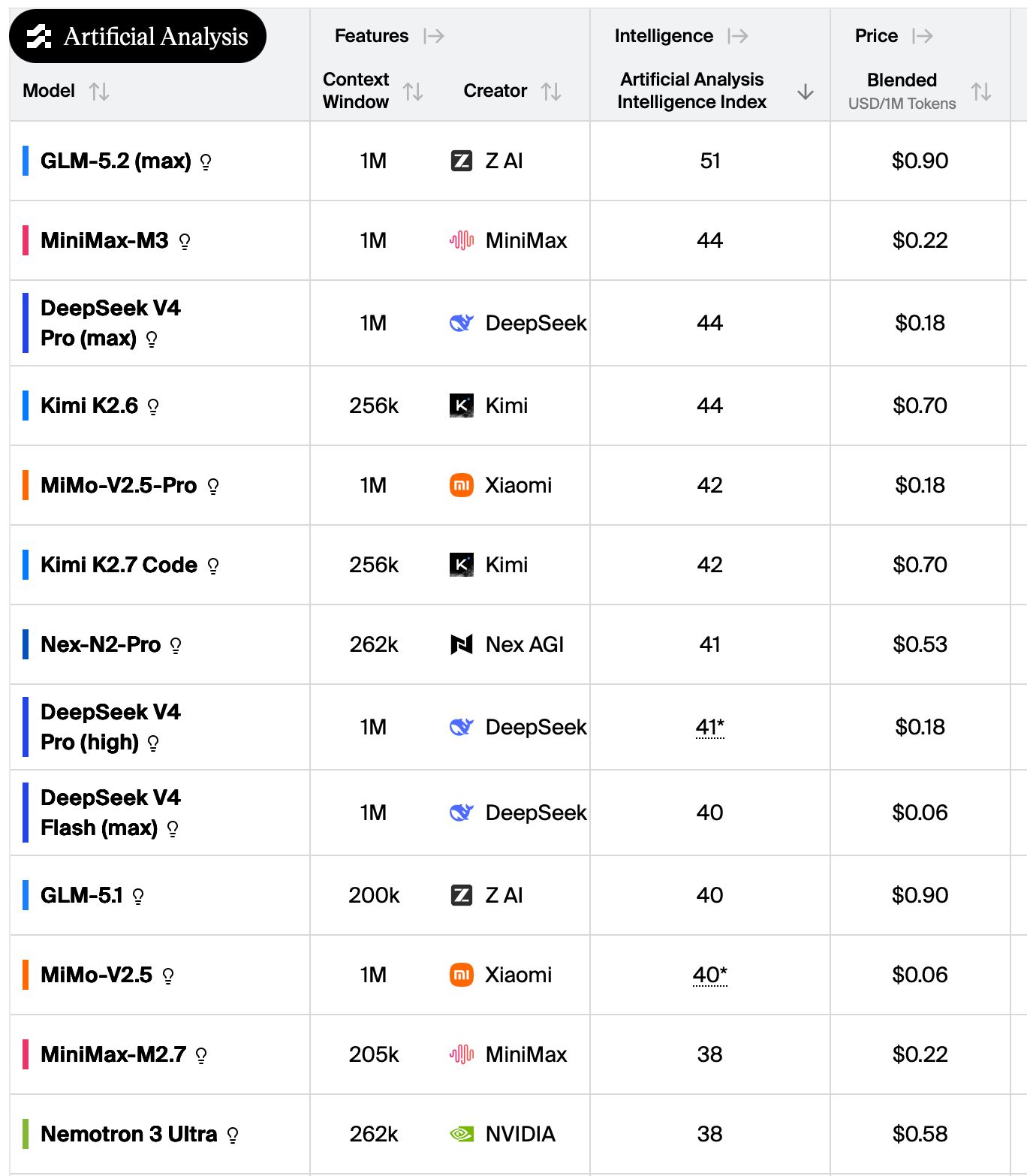
China’s Ministry of Commerce has led meetings with companies behind some of the country’s most advanced large language models (LLMs) to discuss limiting foreign access, Reuters reported yesterday.1 The companies reportedly included Alibaba and ByteDance, whose top products are currently closed, and Z.ai, the company behind GLM-5.2 (max), the world’s top-performing open model by some measures.
What does the Reuters report, based on three “people familiar with the discussions,” suggest about the future of open-weight AI releases out of China? A brief discussion and notes on what to watch…

What’s at stake if China limits open-weight releases?
A Chinese government action to limit the open-weight release of LLMs would be a revealing indicator of what officials are worried about when it comes to the current paradigm of AI.
Releasing a model’s weights means anyone can download it, use it on infrastructure they control without the model maker’s supervision, and adapt it to build new systems. Some people believe open-weight releases already lead to a dangerous diffusion of capabilities in cybersecurity, biology, and other realms. China’s top developers have generally gone for open-weight releases, leading to a diverse and relatively cutting-edge ecosystem of open models out of China that are used around the world. I described this landscape with Stanford colleagues in December, and China’s open offerings still dominate.
The Chinese government has regulatory power at the ready to limit open releases, so the absence of such limits suggests officials are not concerned enough about open-weight models leading to security risks that they deem it necessary to block them.2
This has been a much-watched area. In April, when DeepSeek finally released its long-awaited V4 follow-up model, Alibaba had recently kept its top-of-the-line model proprietary for the first time. DeepSeek’s open release, another by Moonshot AI, and subsequent releases from others including Z.ai suggested Ali’s decision was a matter of company strategy, not government influence—but some of us had wondered it Ali would be a bellwether.
The Chinese government could still decide open-weight releases are too risky or undermine national competitiveness in some way. Something like what Reuters reported would make sense as a first step in such an intervention, but it’s not at all conclusive. Regardless, since Chinese labs provide practically all of the up-to-date open LLMs in the world today, users of open models anywhere stand to be affected.
What did Reuters report, and what should we watch for?
The article, by Fanny Potkin, covers several overlapping themes. I’m focusing here on those relevant to open-weight limits. Here are the key passages:
“At the meetings, led by China’s Ministry of Commerce, participants discussed putting limits on the most advanced AI models — both closed-source and more open versions, according to two of the sources.”
COMMENT: Once a model’s weights are released, it is not possible to limit its use on someone else’s server. In the story’s framing, model makers could be talking about post-training models before open release to limit them in some way or about withholding the most advanced versions from open release (something Alibaba has done already, apparently due to business reasons).
WATCH FOR: (1) Release of closed-only models from labs that previously put out their top product openly; (2) Indications that open-weight models have incorporated government-required limits.
“The scope of the potential restrictions is still being discussed, two sources said, adding that they may only apply to future models. It was not immediately clear when or even if they would come into force.”
COMMENT: There would be no practical effect to post-facto withdrawal of an open-weight release, because there would be copies online, but it’s possible firms would pull them down from their main release platforms as a matter of formal compliance.
Of course, a policy move could come with an explicit announcement and not the reading of cryptic signs from unnamed sources. The Chinese-hosted World AI Conference is coming up again this month in Shanghai, which may be a venue to signal any new approach. Stay tuned.
About Here It Comes
Here it Comes is written by me, Graham Webster, a lecturer and research scholar at the Stanford Program on Geopolitics, Technology, and Governance, and editor-in-chief of the DigiChina Project. It is the successor to my earlier newsletter efforts U.S.–China Week and Transpacifica. Here It Comes is an exploration of the onslaught of interactions between US-China relations, technology, and climate change. The opinions expressed here are my own, and I reserve the right to change my mind.
Quotations are based on a version of the story available via Factiva; I have no reason to believe it’s different.
The leading US LLM developers don’t offer their best models openly, so we don’t get to observe whether the US government would move to limit such releases. Export controls around Anthropic’s Mythos/Fable products suggest they might, but who knows.