

A short note today, and a bit of a provocation.
There is a great deal of debate about how far “ahead” the United States might be in AI, and usually the “lead” is measured in months. While I stand by my earlier argument that the notion of an “AI race” between countries is more confusing than helpful except when it’s carefully defined, we can certainly say that there are differences in utility among various LLM products.
Let’s assume there is a set of tasks that a skilled user (whether an individual, a company, a government, a criminal group, whoever) can today get done with a US LLM product but not with a Chinese one. Take this as a functional definition of a “US lead” without assuming a unilinear development path or some particular destination. Sounds like a safe assumption, and one completely aligned with the consensus idea that the United States is ahead.
Now, should we not at the same time assume there is a set of tasks the same user can get done with a Chinese LLM product but not with a US one? At minimum, we could start with any task that requires relatively high performance on some benchmark AND the ability to run the model on the user’s preferred infrastructure without permission from the developer. In this way, we can understand a “Chinese lead” to exist, at minimum, where openness enables certain uses.
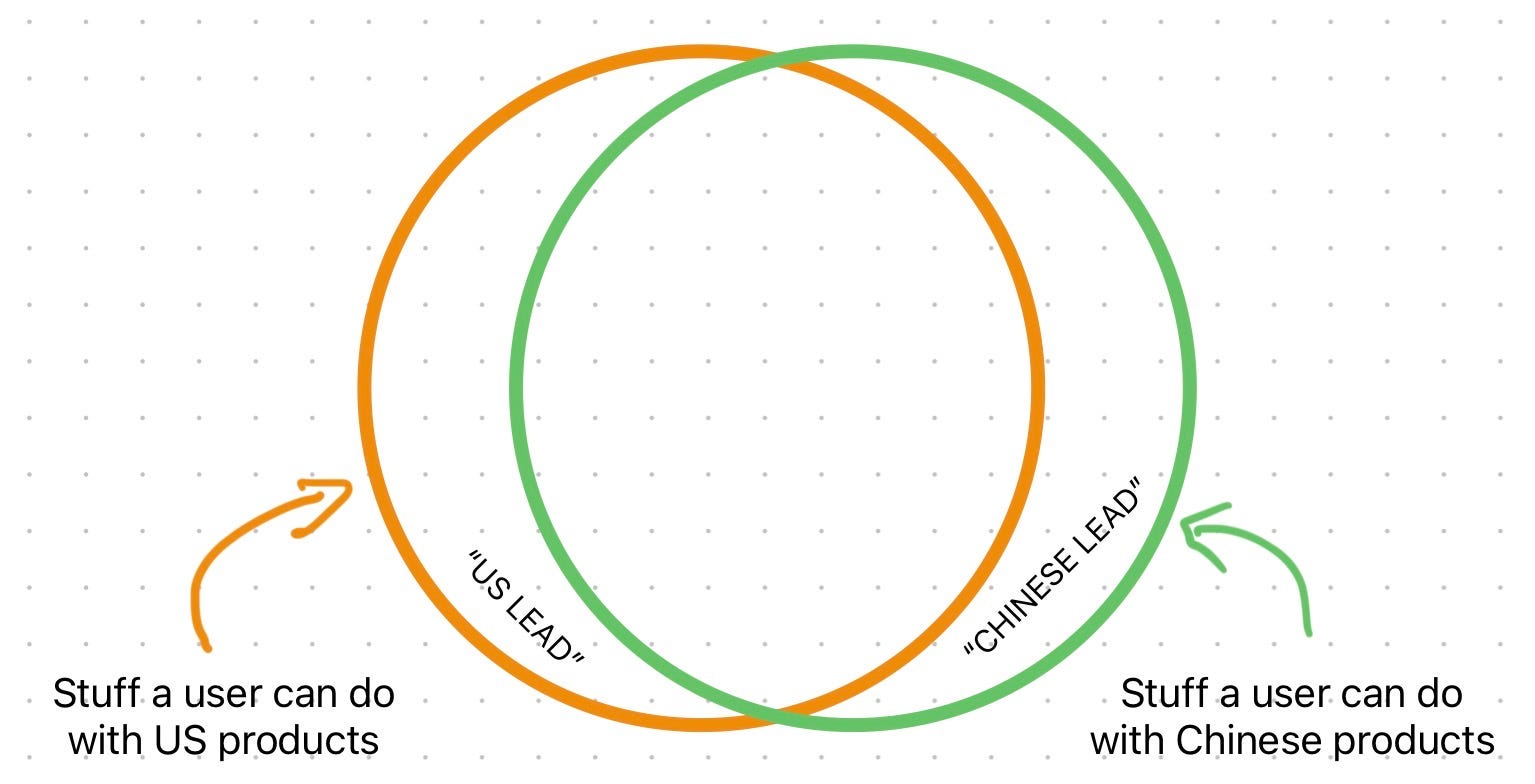
So there you have it. If we understand AI capability as a set of user-task pairs facilitated by a given system, there is a complex landscape of exclusive capabilities. It also means that a lead, or more properly an exclusive capability set, looks different to different users.
A US lead exists, if you like, but only if you recognize that a Chinese lead also exists.1 The other option, of course, is to reject the idea of being ahead or behind in raw technology and focus on specific actual changes in the world.
Let me know what you think. I’ve got covid brain this weekend (it’s still out there, folks!) so may not be my sharpest.
Before I sign off, a little shameless self-promotion:
I was lucky enough to share some thoughts for an NYT article by Meaghan Tobin and Cade Metz headlined “China’s Latest A.I. Breakthrough Threatens America’s Lead.” I think it’s an important piece, and it got me in the brain space of thinking about leads again. To me my most important intervention is that, contrary to an often-heard argument that everything China builds in AI is effectively stolen, “The Chinese models are not excellent only because of distillation. There is real innovation going on.”
I was also lucky to share early thoughts on the announcement of the World AI Cooperation Organization launch in Shanghai with the WSJ, in Jonathan Cheng and Katrina Northrop’s article headlined “China’s Xi Touts Open-Source AI and Takes a Swipe at U.S. Dominance.” Some further details on WAICO (namely the signatories) have emerged since we spoke, but to the extent WAICO is interested in AI governance, my observation stands: “Governing AI risks globally ‘is by definition going to need the U.S. and China both involved,’ said Webster, who focuses on Chinese tech policy. Otherwise, he said, ‘it can’t be a comprehensive global solution.’”
About Here It Comes
Here it Comes is written by me, Graham Webster, a lecturer and research scholar at the Stanford Program on Geopolitics, Technology, and Governance, and editor-in-chief of the DigiChina Project. It is the successor to my earlier newsletter efforts U.S.–China Week and Transpacifica. Here It Comes is an exploration of the onslaught of interactions between US-China relations, technology, and climate change. The opinions expressed here are my own, and I reserve the right to change my mind.