

Twenty years ago I moved to Washington, D.C., after graduating from college. This week I was back for meetings, and a heady if uncomfortably humid nostalgia set in.
If you will indulge me, in the tradition of my occasional series in this space “Didn’t See That Coming” (DSTC), here’s a 20-track DSTC megamix of stuff I would not have anticipated 20 years ago. Plus: a few things I think I would have told you I did think were coming that did pan out.
This is just for fun, but it’s also something I’ve been thinking about when I speak with students and younger folks about their future plans. One of my most consistent messages is that, at least for a path like mine, you couldn’t plan it out on purpose if you tried.
Didn’t See That Coming: Megamix
#20: A D.C. Metro line to Dulles airport. The cars were old, the stations were epic brutalist displays that felt poised for use as fallout shelters, and adding Dulles to the map seemed pie-in-the-sky.
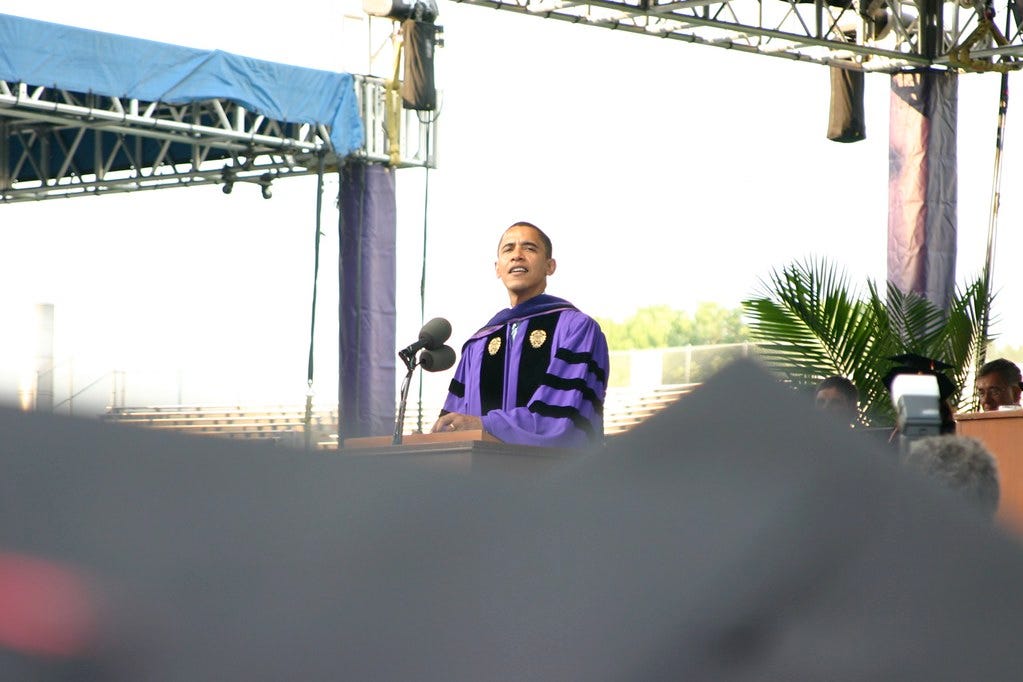
#19: Two White House terms for the junior senator from Illinois and Northwestern ’06 commencement speaker. I liked his clarity against the Iraq War, and it was a great speech, but at this point in 2006 I wouldn’t have even bet on Barack Obama in a primary.
#18: President Donald Trump. Obviously. Holy hell.
#17: A cumulative ~four years spent in Beijing, but mere weeks in Japan. In 2006 I finished a senior thesis on Sino-Japanese relations, and I decided I would start learning Mandarin and move to Beijing for the year leading up to the 2008 Olympics. But I’d spent time in Japan and had passable Japanese, and I would not have guessed that China would so dominate my professional life over the next 20 years.
#16: Trader Joe’s on 14th St. NW. I’m not even sure I had ever seen a Trader Joe’s. The first visit I remember might have been 2007 in Palo Alto. But by the end of that year I knew 14th St. NW and it continues to amaze.
#15: China’s centrality to advanced technology supply chains. I knew a lot of electronics were made there, but I didn’t even know how to ask whether this might lead to whole categories of to-be-developed technology that is really only available from China.
#14: China’s sustained turn toward repression. It’s not as if I thought in 2006 that the Internet would cause freedom in China. My college thesis had analyzed tech use both for mobilization of protest in China as well as party-state efforts to tamp it down. Yet China appeared to be trying to open, and it would be two or three years of before the progressively less free course we still see today would take hold. Stuff changed and it will again.
#13: The blogosphere is dead. Long live the newslettersphere! I’ve had personal “Web sites” and blogs since I was a preteen. In 2006, blogs were king (though I had argued news orgs should innovate further given their resources). The death of the blogosphere at the hands of Twitter and its reinvention through Substack and others would have blown my mind.
#12: The attention-abusing intrusiveness of social media. In June 2006 Facebook still seemed exciting and fun. That September, when the introduction of the “News Feed,” I would realize this was on a path many of us wouldn’t enjoy and that our sense of intimacy and privacy was an illusion.
#11: I would learn a ton about the UN Convention on the Law of the Sea by a decade later, and then forget most if it as another decade passed.
#10: Teaching grad students at Stanford. I knew I wanted to go back to school—for international policy or Asian studies or something. I don’t think I anticipated my future would involve teaching real adults at a serious and fancy university.
#9: I like sour cream now. More specifically, Mexican crema. This happened when a roommate in Seattle introduced his nachos method.
#8: I really liked graduate social science statistics. In high school, math was interesting but a bit of a drag. A required stats course as a journalism major sparked no interest. Prof. Chris Adolph’s year-long sequence at University of Washington permanently upgraded my BS detector and, later, made it possible to kind of understand machine learning.
#7: I went for a PhD in political science. I didn’t have much understanding of the discipline, and I wouldn’t understand that it was a potential path forward until studying for my master’s.
#6: I quit the PhD. Pretty sure 2006 me would have assumed I’d finish what I started, but turns out I was willing to change course when it turned out I didn’t see the path I’d hoped for. Good.
#5: A string of half marathons. Circa 10 years later I would start doing about one a year. I don’t think I’d ever run more than 7 miles by 2006, nor did I want to. Hope I can continue.
#4: AirPods. Absolutely wild.
#3: Friendships that snake around the world. You meet people in one chapter, and they show up somewhere else. I think when you’re 22 this is incomprehensible.
#2: The things you can remember. The nervous sensation of being a Colorado kid in a think tank meeting with people who seem so important, it turns out, can waft through your awareness when you are one of those people (not important) going about a regular day at a think tank table.
#1: The things you don’t remember. As a young journalist I would remember what people said verbatim, without trying, for a couple of hours. Where did this tool go? And what else didn’t I see coming that there’s no way to recall?
Saw that coming (please clap).
The iPhone. When Steve Jobs announced the iPod in 2001, I was disappointed that after the build-up it was only a music player. I already thought it should be a phone, and it took them six more years to catch up to my vision.
Living in Northern California. I was at least going to give it a try one day.
Not really picking a career lane. By 2006 I was figuring out that journalism alone wouldn’t do it for me, nor would straight policy work, nor traditional academics. I think I’d have accurately guessed some kind of blended path would continue to unfold.
OK, back to regular programming next time. If you want, reply or share this post with your favorites, your own shockers, or the times you saw what I couldn’t see.
About Here It Comes
Here it Comes is written by me, Graham Webster, a lecturer and research scholar at the Stanford Program on Geopolitics, Technology, and Governance, and editor-in-chief of the DigiChina Project. It is the successor to my earlier newsletter efforts U.S.–China Week and Transpacifica. Here It Comes is an exploration of the onslaught of interactions between US-China relations, technology, and climate change. The opinions expressed here are my own, and I reserve the right to change my mind.